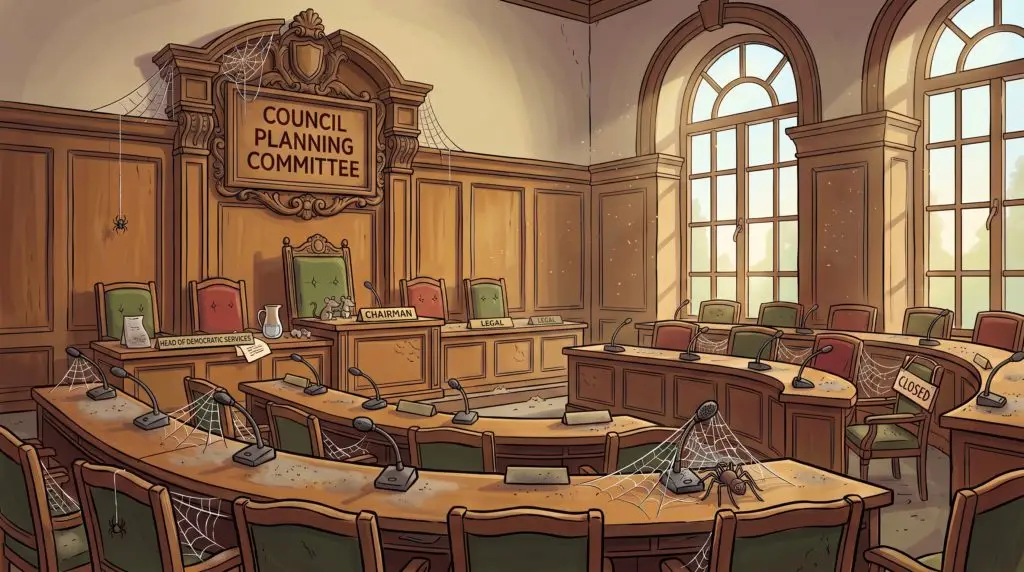
From 31 October 2026, the government’s new National Scheme of Delegation will standardise planning decision-making across England. While planning officers already handle roughly 96% of decisions, local councils currently run on a patchwork of local rules. The National Scheme of Delegation replaces this with a single national rulebook.
Here is what is changing, how it works, and what it means for your next project.
How the New System Works
Introduced via the Town and Country Planning (Discharge of Local Planning Authority Functions) (England) Regulations 2026, the scheme splits applications into two clear tiers:
- Schedule 1: Covers householder apps, minor commercial/residential schemes (up to 9 homes or under 0.5 ha), discharge of conditions, prior approvals, and minor amendments, among others. Officers must decide these schemes with no planning committee involvement, regardless of public objections or parish council pushback.
- Schedule 2: Covers everything else: major developments, large outline permissions (500+ dwellings or 50,000 sqm+), advertisement consents, TPOs, and listed buildings, among others. Officer determination remains default, but a scheme can go to committee only if both the Chief Planning Officer and Committee Chair agree it meets a strict “gateway test” (a scheme that raise issues of local economic, social, or environmental significance; or a significant planning matter). If they disagree, it stays with officers.
Key Exception: Applications submitted by the council itself or involving council members/officers remain outside Schedules 1 & 2 to preserve public scrutiny and prevent conflicts of interest.
Key Takeaways for Developers and Applicants
- Local Politics Take a Back Seat: Ward councillors lose their “call in” powers, and objection volume thresholds vanish. Political lobbying will be largely redundant for Schedule 1 and heavily reduced for Schedule 2.
- Early Officer Engagement is Everything: Because public pushback no longer triggers a committee referral, many decisions will hinge more strictly on planning policy. Front-loading pre-application discussions and building strong officer relationships early in the process will be crucial to resolving technical issues.
- The Chief Officer–Chair Dynamic: For Schedule 2, both the Chief Planning Officer and Committee Chair must agree to trigger a committee referral. Even with new delegated powers, Chief Planning Officers cannot operate in a vacuum; they must carefully manage political relationships with their Chairs.
- Faster Decisions and Eased Resource Pressures: Committees are capped at 13 members with streamlined agendas. Beyond reducing deferrals and cancellations, increasing delegated powers allows for shorter, more focused officer reports. Cutting administrative burden frees up council capacity, helping speed up overall determination times across the board.
- Will Committee Refusals Spike? With routine schemes removed from agendas, members will handle fewer applications overall. However, because members won’t be bogged down by minor items, expect them to scrutinise remaining schemes far more intensely – potentially driving up refusal rates for applications that reach committee stage.
The Legal and Political Reality
Councils must adhere strictly to these delegation rules. Any planning committee that purports to determine an application legally designated for officer delegation exposes its decision to Judicial Review.
While a handful of local authorities have resisted updating their internal constitutions, the legislation takes immediate precedence.
Crucially, because the National Scheme of Delegation is secondary legislation under the Planning and Infrastructure Act 2025, it can be amended or rolled back by future ministers without a primary Act of Parliament. Planning policy in England has always been defined by an ongoing tug-of-war between centralisation and local discretion – meaning there is no guarantee this national model will survive unchanged beyond the current Parliament.
Navigating the Changes with hgh Consulting
On the surface, the National Scheme of Delegation feels like a treat for developers—but managing its real-world implementation is where the true test lies. Predictability on paper doesn’t guarantee an easy ride, particularly when local authorities begin interpreting the Schedule 2 “gateway test” or navigating live applications through the transition.
This is where hgh Consulting brings unmatched value.
Our strength lies in our local intelligence and established relationships across local authorities. We know how different planning departments operate, how Chief Planning Officers and Chairs interact, and where local political friction points lie. That insight allows us to give you a clear strategy from day one.
If you want to ensure your planning strategy turns these regulatory shifts into a distinct advantage, get in touch with the hgh Consulting team.
Ellie Fowler
[email protected]m
23 October 2026