One of the less publicised tools of the Secretary of State is an Article 31 Direction. The Secretary of State is empowered to issue such a Direction whenever she thinks it appropriate to put the brakes on a local planning authority making a planning decision.
A number have been issued recently in respect of development schemes in which hgh have some involvement or interest.
In late 2024, Angela Rayner issued a Direction that the City of London Corporation should not to grant permission for Welput’s 43-storey tower at Bury House, 31 Bury Street, EC3. This was in response to concern on the part of some influential objectors that the Corporation was about to grant permission for a development that would have severely harmed the setting of the historic Bevis Marks Synagogue. The application was subsequently refused.
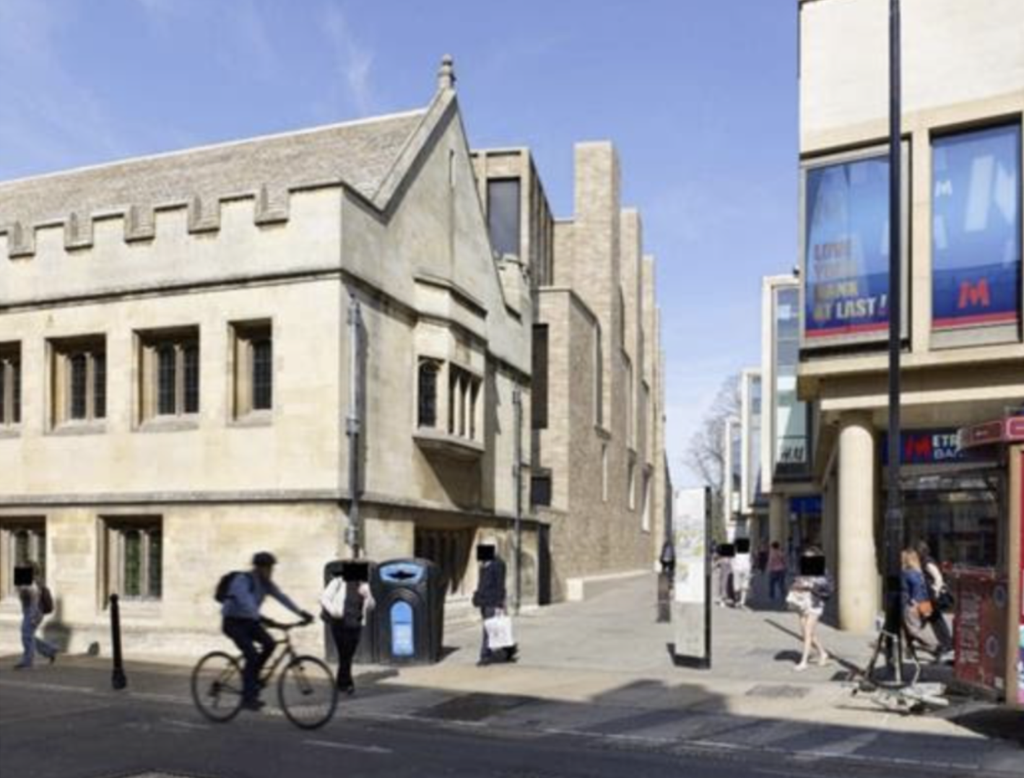
Earlier this month, she directed Cambridge City Council not to grant permission for a new library at Christ’s College, Cambridge. Again, this was in the context of the Council preparing to grant permission for something that is highly controversial because of its heritage impact. In this case there is an added dimension in that the application is identical to one that was permitted previously, where the Council and the applicant had agreed to accept a quashing order following a High Court challenge, but where the High Court judgement had not been handed down.
While the two instances above both relate to concern about heritage impact, another one is very different. Kingston Upon Thames Council refused permission (against officer advice) for a 586 home flatted scheme by Berkeley Homes. The site is previously developed land in Metropolitan Open Land. The Mayor of London called the application in and the Deputy Mayor, Jules Pipe, granted permission following a hearing. Shortly afterwards, in August 2026, Rayner issued an Article 31 Direction.
All could be seen as standing in the way of development and economic growth, which is at odds with the Government’s general stance and with Matthew Pennycook’s recently proclaimed “universal tilt”. The common thread seems to be that all involve something that is unusual, and where the correct planning approach may not be entirely clear. At Bury Street, the issue was a head-on conflict between growth and heritage objectives in a situation where the City Plan was unresolved. At Cambridge, it is again conflict between growth and heritage, now in the context of the new NPPF, with the added dimension of an aggressive application strategy that seems disrespectful of the High Court. At Motspur Park, it is unclear what the issue is, though it may be the uncertainty as to how policy towards Green Belt (or Grey Belt) is or is not applicable to Metropolitan Open Land.
Roger Hepher
[email protected]
26 October 2026